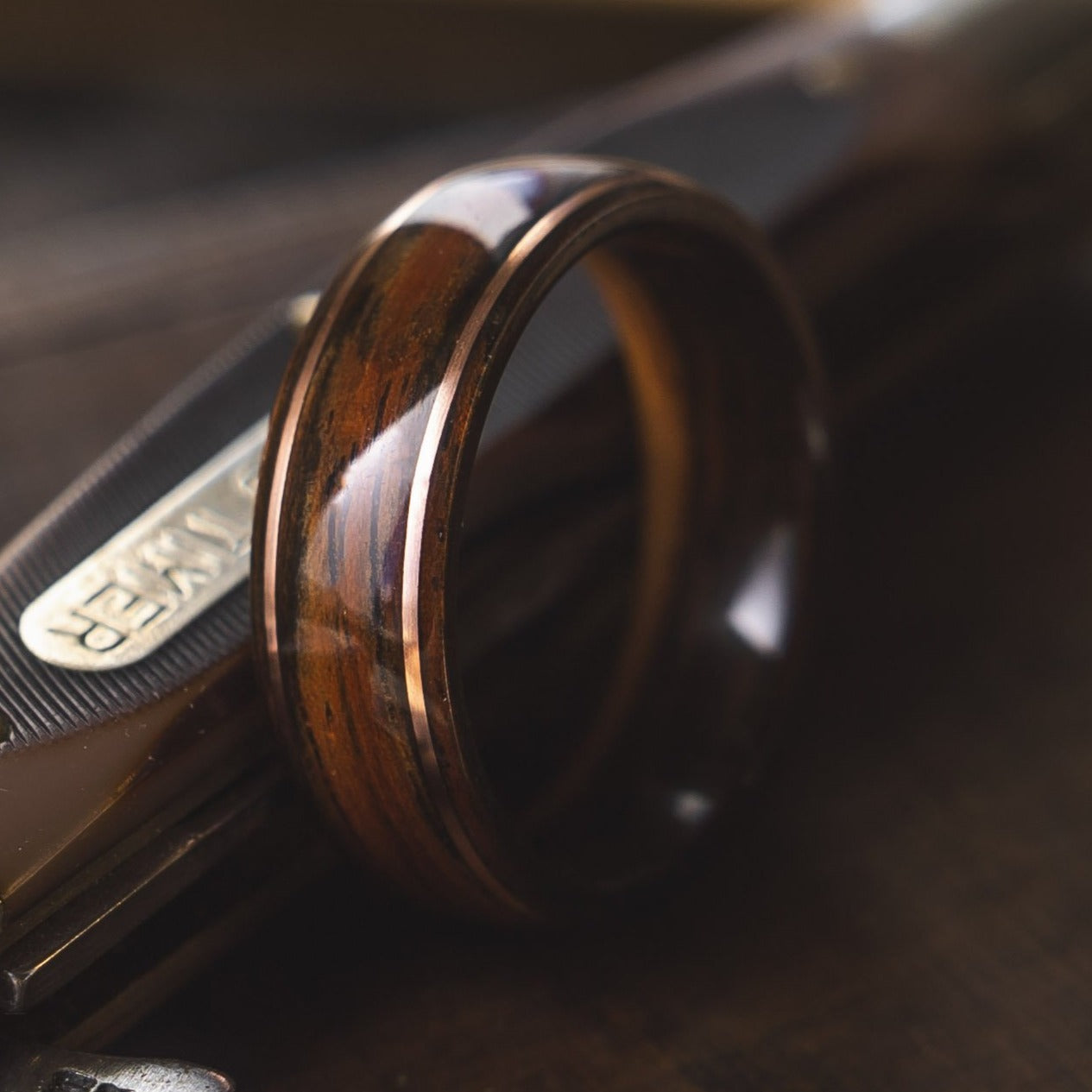
The word bentwood might sound technical, but the process is surprisingly visual. It starts with veneers — extremely thin sheets of wood that are cut from larger stock on a precision bandsaw. Each veneer is about the thickness of a playing card, sometimes less.
Once cut, the veneers are stacked in a specific order. A design like the Santos Rosewood Double Offset Copper might have 12 to 16 individual layers: alternating layers of rosewood with thin copper wire sandwiched between them. The number of layers determines the ring's final width.
The stacked layers are then steamed. Steam makes the wood pliable without cracking. At that point, the layers are compressed in a custom mold and clamped until they cure. The curing process is where the ring gets its shape — and its strength.
After drying, the ring is rough-sanded on a drum sander to bring it out of the mold shape. This is followed by hand-sanding through progressively finer grits until the surface is smooth enough to feel against the skin. It is the stage where we separate hand-finished rings from factory-finished ones.
The final step is finishing. Our clearcoat is CA glue, which is the hardest finish available at this moment, sealing the wood against water, sweat, and daily wear. Each ring receives multiple thin coats with hand-buffing between each layer. The result is a polished, waterproof, durable surface that showcases the grain underneath.